


e-Sword: Bible Study to Go
Rick Meyers
I approached e-Sword: Bible Study to Go as a pocket reference library rather than as a casual reading app. That distinction matters. Its purpose is to help you study Scripture, compare material, and keep useful reference content close at hand, not simply provide a minimalist page-turning experience. After spending time with it, I found the strongest reason to consider it is the way a paid app can turn a phone into a compact study desk without pushing you toward a recurring payment.
The app belongs to the Books & Reference category and is developed by Rick Meyers. It has built a solid audience, with over 100 thousand installs and a 4.7 average from around 2.4 thousand ratings. Those figures suggest that it is reaching people who want more than a basic Bible reader, although popularity alone does not make it suitable for every kind of reader.
What you are paying for and what that changes
The listed price is $2.99, so this is a paid download rather than an app presented as free access. That makes the buying decision pleasantly straightforward: you are evaluating whether the study-library approach is worth a small one-time purchase, not trying to calculate how much a subscription may cost over time. I appreciate that clarity, especially for an app I might use occasionally rather than every day.
Its age rating is Everyone, which fits the broad audience for a Bible reference tool. The app was released on Jan 13, 2022, and the current version is 7.1.0. It requires at least OS 10, so compatibility is worth checking before purchasing, particularly if you keep an older device for reading or travel.
The price should not be interpreted as a promise that every possible study resource is automatically included. The practical value is in the app itself and in how comfortably it lets you work with its library-style approach. I would think of the purchase as paying for a focused study environment, not as buying access to every book, translation, or resource someone might want in the future.
Related News

Why WhatsApp Messenger Still Makes Everyday Communication Feel Easy

Jurassic World: The Game Is the Better Dino Tycoon for Strategic Players

Threads in Real Life: Who Should Join, Lurk, or Leave

How SHEIN Turned Shopping Into an Endless Content Feed

How to Make Fortnite Feel Smarter on Mobile

Should You Switch to Microsoft Outlook on Mobile?
That distinction also helps explain why this app can be a better fit than a free Bible reader for one person and a poor fit for another. If your only requirement is opening a familiar passage and reading it with no extra structure, a free alternative may already do enough. If you regularly move between text and reference material, the modest purchase becomes easier to justify.
A library mindset instead of a single-purpose reader
My first useful adjustment was to stop treating the app like a digital paperback. A normal reading app encourages a linear routine: choose a book, select a chapter, and read. e-Sword: Bible Study to Go feels more useful when you approach it with a question. You can begin with a passage, investigate a word or theme, compare what you are reading with supporting material, and then return to the text with a clearer purpose.
That workflow is particularly helpful for personal study. I can imagine opening it before a small-group discussion, checking a passage that came up in conversation, or preparing notes for a short devotional. The phone format means the reference shelf is always nearby, but the app still rewards a deliberate approach rather than hurried tapping.
Gallery
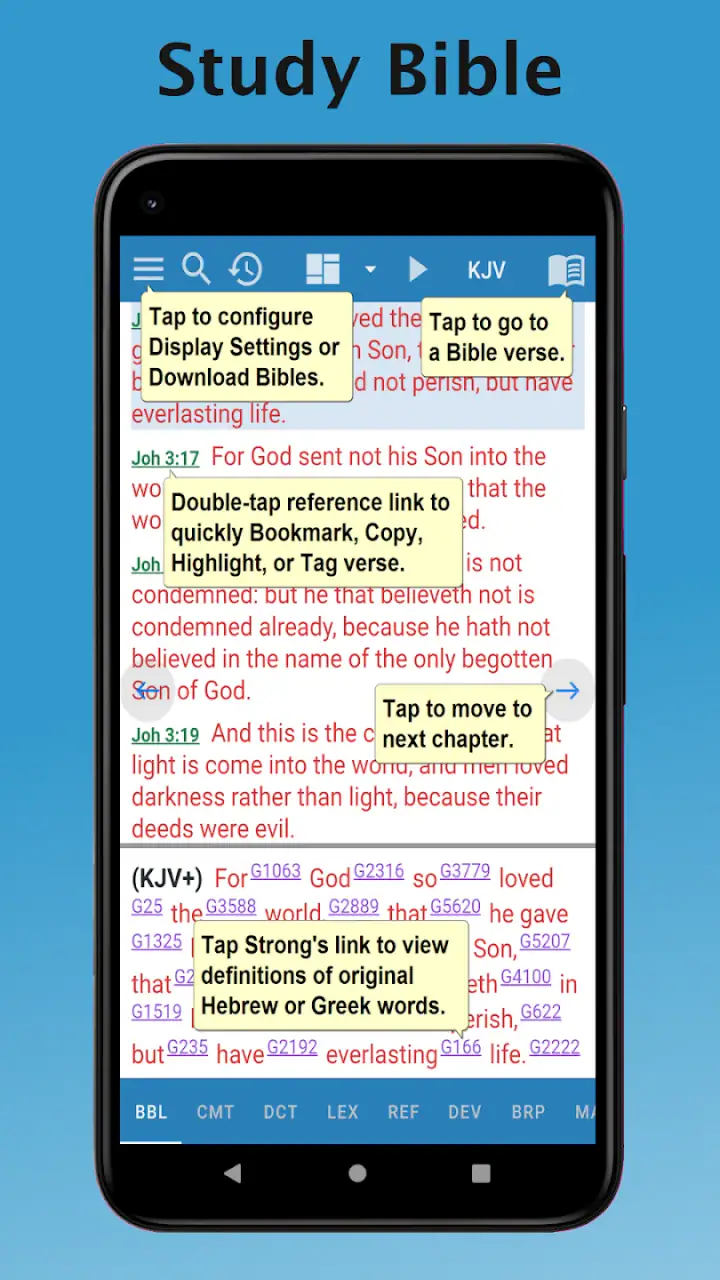
The phrase “seminary library” in its store summary sets an ambitious expectation. I would read it as a description of the app’s intended breadth and study orientation, not as a substitute for formal theological training. It can support reading and investigation, but it does not remove the need to judge sources, compare interpretations, or understand the historical setting of a passage.
How I would use it in an ordinary week
A realistic scenario would be a Sunday evening when I am preparing for a discussion about a short biblical passage. I would first read the passage without interruption, note the words or ideas that seem unclear, and then use the reference material to investigate those points. Instead of opening several unrelated apps and losing the thread, I could keep the study centered in one place.
The same routine works for a quieter personal habit. I might read a chapter during a commute or lunch break, mark a question mentally, and return to it later when I have more time. The app is most valuable in that second stage: it helps turn a quick reading session into a more intentional study session.
There is also a useful trade-off here. A phone is convenient, but it is full of distractions. A printed study Bible is slower to update and less portable, yet it can be easier on the eyes and less tempting to abandon for messages or social media. I would use this app when portability and searchable reference work matter more than the calm physical experience of paper.
Where the paid value is strongest
The strongest value comes from combining several study tasks in one focused tool. I do not have to treat reading, checking a reference, and returning to the passage as completely separate activities. That continuity is more important than a flashy interface because serious study often involves small movements back and forth.
It also suits readers who want a reference collection without carrying multiple physical volumes. That is valuable for travel, commuting, or anyone whose bookshelves are already full. The phone is not a perfect replacement for a large printed library, but it removes the physical burden and makes spontaneous study more realistic.
Another advantage is consistency. When I use a single environment for recurring study, I am less likely to lose track of where I was or which passage prompted a question. This is not the same as claiming that every person will find the interface effortless. It means the app’s structure can reward a repeatable routine once you learn how you prefer to navigate it.
I would also treat the purchase as a low-risk way to test whether deeper Bible study belongs in my daily phone habits. At $2.99, the decision is small enough for someone who is curious about a dedicated reference app, while still requiring more commitment than downloading another free reader that may never be opened again.
Three practical habits that make it more useful
First, I would separate reading from investigating. On the first pass, I would read the passage without chasing every reference. On the second pass, I would choose only the questions that genuinely affect my understanding. This prevents the library aspect from turning every short reading into an exhausting research session.
Second, I would use it as a comparison aid rather than an automatic answer machine. When a note or reference gives an interpretation, I would ask what part is observation and what part is explanation. That habit protects against accepting a convenient comment without considering the wording and context of the passage itself.
Third, I would build a small personal routine around recurring questions. For example, I might keep returning to unfamiliar terms, repeated themes, or passages connected to a current study topic. The benefit is not merely finding one answer; it is learning how to investigate in a consistent order. That makes the app more valuable over time than a tool used only for occasional searches.
A fourth tip is to avoid measuring its usefulness by how quickly it opens a verse. Speed is important, but the real test is whether it helps you understand why you opened that verse in the first place. If you use it only as a lookup box, you may be paying for a broader study experience while using a fraction of what makes it distinctive.
The friction I would consider before buying
The main limitation is that a study library can feel heavier than a simple reader. More material means more decisions: which resource should I consult, how much background do I need, and when should I stop researching? Readers who want an uncluttered devotional experience may find this approach more involved than necessary.
There is also a learning curve in any app that tries to serve serious reference work on a small screen. Even when the content is useful, navigation can require patience. I would not recommend buying it five minutes before an important study session and expecting to use every part immediately. Give yourself time to understand the layout and develop a comfortable workflow.
The phone itself creates another compromise. Long sessions can be less comfortable than reading a printed Bible or a larger tablet display. Notifications, battery concerns, and the temptation to switch apps are not faults unique to this product, but they affect the experience. I get the best results when I decide in advance what I am studying and keep the session focused.
Finally, the paid model means I would not choose it automatically for someone who refuses paid apps, even when the price is modest. A free alternative may be the better recommendation if cost is the only priority or if the person needs nothing beyond basic reading. The purchase makes sense when the reference-library concept addresses a real need.
Who will get the most from it
I think the best audience is made up of curious Bible readers, students beginning a more structured study habit, church discussion participants, and anyone who wants reference material available without carrying a shelf of books. It can also suit people who prefer a one-time purchase over an ongoing subscription, provided the app’s included experience matches what they expect.
It is especially appealing if you often ask questions such as “How does this passage connect with the surrounding text?” or “What should I investigate before forming an opinion?” Those questions naturally lead to a library-style tool. The app gives your reading a place to expand instead of forcing you to leave immediately for a web search.
I would be more cautious about recommending it to a brand-new reader who feels overwhelmed by biblical vocabulary or structure. A simpler guided reading app may provide a gentler beginning. Likewise, someone who needs extensive academic resources, specialized scholarly databases, or a full desktop research workflow may eventually need software designed for that level of work rather than relying on a mobile app alone.
It is also not my first choice for someone who mainly wants audio listening, a beautifully minimal reading screen, or a device-free devotional routine. Those priorities point toward different tools. This app earns its place when investigation and portability matter more than simplicity.
How it compares with familiar alternatives
Compared with a standard free Bible reader, this app is more appealing when I want to move beyond the passage itself. Free readers often win on immediate accessibility and simple navigation. They are excellent for opening a chapter quickly. e-Sword: Bible Study to Go makes a stronger case when the next step after reading is consulting reference material and continuing the thought in the same study session.
Compared with a printed study Bible, the app wins on portability and the ability to keep a larger reference habit in a phone. The printed book wins on comfort, focus, and the physical sense of seeing notes beside the text. I would not call one universally superior. I would use the app away from home and keep paper nearby for longer, distraction-free sessions.
Compared with a web search, the app offers a more intentional environment. Searching the open web can produce useful results, but it can also lead to unrelated pages, conflicting explanations, and interruptions. A dedicated study app narrows the activity. The trade-off is that a web search may expose a wider range of material, while the app encourages a more contained workflow.
Compared with advanced desktop Bible software, this mobile version is easier to carry and likely easier to open for a short session. A desktop setup may be preferable for extensive note-taking, large-screen comparison, or research that involves many windows. I see this app as a practical companion for everyday study rather than a complete replacement for every serious desktop tool.
Support, maintenance, and everyday confidence
The developer is Rick Meyers, and the app has continued to the current 7.1.0 version. For me, that matters because a reference app becomes more useful when it feels like an ongoing product rather than a forgotten download. I still would not buy it solely because of a version number; the real question is whether the current experience fits my reading habits.
The minimum requirement of OS 10 is another practical checkpoint. On a compatible device, I would install it before planning an important study session and spend a little time browsing. That simple test helps answer the questions that screenshots cannot: whether the text feels comfortable, whether navigation makes sense to me, and whether the library approach feels helpful or crowded.
Because the app is rated Everyone, it is broadly approachable from an age-rating perspective. That does not mean every child will find a reference library easy to use, but families can at least consider it without the age classification itself being a barrier.
My buy-or-skip verdict
I would buy e-Sword: Bible Study to Go if I wanted a compact Bible study library and preferred a one-time $2.99 purchase to a subscription-based habit. Its value is not in replacing every other Bible resource. Its value is in making a more deliberate study workflow available on a phone, especially when I want reading and reference work to stay connected.
I would skip it if I only needed a basic free reader, disliked studying on a small screen, or expected a full academic research suite. I would also skip it if I was unwilling to spend even a small amount on an app before knowing whether I would use its broader approach.
For the right reader, the purchase is easy to understand: pay a modest amount for a focused reference environment, then use it actively rather than treating it as another icon. My honest recommendation is to choose it for questions, comparisons, and recurring study—not merely for opening a verse. Used that way, it offers more lasting value than its small price suggests; used only as a quick reader, a simpler free alternative may be the smarter choice.
FAQs for e-Sword: Bible Study to Go
What is e-Sword: Bible Study to Go?
e-Sword: Bible Study to Go is a mobile Bible study application designed for reading, comparing, and researching Scripture on an Android or iOS device. It typically combines Bible translations, commentaries, dictionaries, devotionals, and study tools in one interface. The exact resources available may depend on the platform, app version, and modules installed by the user.
Does e-Sword: Bible Study to Go work offline?
The app is intended to support Bible study away from a constant internet connection, especially when the required Bible versions and reference materials have already been downloaded. However, initial downloads, updates, purchases, synchronization, or access to certain online features may require Wi-Fi or mobile data. It is best to prepare your preferred resources before traveling or studying without reliable internet access.
Is e-Sword: Bible Study to Go free to download?
The application may be available as a free download, but some Bible translations, commentaries, dictionaries, study books, or advanced features can require separate purchases or in-app access. Availability and pricing may differ between Android and iOS. Before downloading additional content, review the store listing and the app’s resource catalog so you understand which materials are included and which are optional.
What study features does e-Sword provide?
e-Sword focuses on practical Bible research rather than simple reading alone. Depending on the installed resources, users can compare multiple translations, search for words or passages, consult commentaries and dictionaries, read study notes, and organize personal observations. These tools are useful for devotional reading, sermon preparation, group study, and more detailed examination of biblical passages.
Is e-Sword: Bible Study to Go suitable for beginners?
Yes, beginners can use e-Sword for straightforward Bible reading, but the number of available resources may feel overwhelming at first. Starting with one familiar translation and learning the search, comparison, and notes features gradually makes the experience easier. More experienced users will likely appreciate the broader reference library, while newcomers can keep the interface focused on basic reading and devotional study.
Pros
- Includes multiple Bible translations and study resources in one app.
- Strong search tools make it easy to find verses and topics.
- Works offline
- making it useful without mobile data or Wi-Fi.
- Notes
- highlights
- and bookmarks help organize personal study.
- Suitable for both casual reading and detailed Bible research.
Cons
- Some translations and resources may require separate purchases.
- The interface can feel dated compared with newer Bible apps.
- Large resource libraries may take considerable storage space.
- Advanced study tools can be overwhelming for first-time users.
- Sync features and resource availability may vary by platform.


